

Is attention countercultural?
Simone Weil's insights and beyond

While researching attention, I found a soulmate in Simone Weil. She too was someone who was interested in the problems more than the answers, or, put another way, the process more than the result. A similar idea exists at the heart of Martin Luther King, Jr.’s commitment to non-violent protest. As King explained in a 1960 interview on “Meet the Press”: “I do not feel that the end justifies the means because the end is preexistent in the means, and I believe firmly that we must follow moral means to secure moral ends.” As both of these philosopher-activists sought to offer up cures for the human condition, Weil’s focused on attention. But not the attention we typically think of or engage in towards each other. The “muscled” performance we act out when we attempt to show our attention to another in conversation—the wrinkled brow, the nodding, the um hum’s and indeed’s—this is the exchange of social currency, as Robert Zaretsky explains on an episode of The Gray Area. In these moments, we perform attention as we insist to each other that we are listening and paying attention. As you can see, the insistence benefits mostly our own ego. What Weil meant by attention entailed a removal of ego—hers was an attending to another, a bearing witness, a patient and indeed selfless offering and as such “we can only attend to the world when we stop attending to ourselves.”
During the summer after my sophomore year in college, I was behind in credits. I had transferred away from an unhappy college situation and taken a semester off to help my father get his new business off the ground. When I returned to school, I felt an urgency to catch up. The need to graduate on time felt, oddly now as I look back, compellingly imperative.
I signed up for a couple of courses at Harvard Summer School, the courses chosen for no particular rhyme or reason other than my own interest, my own gut feeling that they may shed new light on previously unknown perspectives. The first course was a History of Science course titled Einstein, Darwin, and Freud. As with many things that I have begun to recognize about myself as I age, I can see the personal appeal of this course now with its crossing and connecting of disciplines. The second course I took was taught by John Stilgoe, a rather well-known figure in the history of landscape development. It was titled, confoundingly to me at the time, Crucial Issues in Landscape Development and Change from 1890 to the Present. it was described as:
a lecture/slide/video course emphasizing the chief forces now shaping American understanding of everyday form, such as the manipulation of aesthetic standards by advertising and Hollywood imagery; the perfecting of powered flight and the aerial view; the importance of snapshot photography in relation to home video; the post-1960s fascination with outdoor privacy; contemporary and potential spatial disorientation resulting from computer-aided electronic media; the post-1920 retreat of well-educated people into wilderness; the shaping of gender roles and self-image through clothing design and fashion shifts; and the long-term impact of national advertising campaigns on American notions of quality, uniqueness, proportion, and pleasure as reflected in ordinary visual realms.
There are moments in life when your brain expands, the growth as dizzying as it is exhilarating. Professor Stilgoe’s course was one of those moments for me as he introduced a way of seeing the American landscape and its interconnected elements—highways, signposts, farms, malls, suburbs, billboards—and the reflection of these realities and dreams in poetry, media, films, and advertising. This was a class where we went seamlessly from looking at photographs of a highway roadside gas station to reading poetry by Donald Hall to considering 1950s advertisements about travel.
Beyond the indelible way this course altered my outlook on the world and imprinted itself on my future thinking, Professor Stilgoe’s class also pushed me into different ways of being in the world. He was continually urging us to walk slowly, even slower, slower still, not to be in a hurry to get somewhere, but to dawdle in the service of actually noticing how the world around us had come to be what it was and to ask questions of its current state and past development. Even with his repeated admonishments, it seemed a bit silly to me at the time. I was in a hurry, I did need to get somewhere, and honestly, I preferred running.
In 2020, when the pandemic stopped the world as we knew it and opened up new, often uncomfortable ways of being in the world, walking became an increasingly popular activity. Walking became the only physical activity and outlet from home lockdown for many. Certainly, for me. But now, as I suddenly had more time than ever to walk far and fast, I found myself walking more slowly. Each of the hundreds of times I walked around my neighborhood, my feet took longer and longer to pedal me forward. Once I knew every house, I slowed to know the placement of every window. Once I could recognize each window, I slowed to notice the location of trees and plantings. Once I began to remember the flora of my neighborhood, I slowed to watch a dragonfly in summer, or the way breath dissolves in winter. I listened to hawks gliding, air conditioners humming, and sometimes—though not often enough—the occasional sound of a child laughing.
As my walks slowed, I found myself noticing more, experiencing the world around me with heightened awareness. It brought to mind a fascinating perspective on attention and perception that I'd encountered in Michael Pollan's exploration of psychedelic therapy (the use of LSD, MDMA or psilocybin to treat depression, anxiety, or trauma). Pollan first became interested in this field when a developmental psychologist he was at dinner with spoke of an LSD trip, explaining that it had enabled her to have a better window into the way children think. As infants cannot yet distinguish between what is or may be of greater importance to them, they observe everything in their world with equal fascination and initially take in information through all of their senses capturing the essence of a thing though not necessarily its details. Though I could never reach this way of letting the world wash over me, I came closer as my walking slowed.
So often, slow has a negative connotation–your computer is slow; traffic is slow; your start to your career is slow; your progress is slow; the economy is slowing—but the reality is not binary, not clear at the outset. We all know the fable of the tortoise and the hare, but it is worth thinking too about slow altogether separated from fast, not as an alternative, not in a race, but as its own way of being in the world.
For me, slow is an attendant to attention of the kind Weil sought. The great disruptor may well be rational—or at least goal-driven—thought. As Weil wrote: “The great human error is to reason in place of finding out.” And so I think that it is worth spending some time finding out about attention—what it is, how has it been corrupted or manipulated, how might we direct it or, even better, how might we slip from our attention to ourselves. The crucial question may not be how we can control our attention, but rather: can we give in to it? Can we allow ourselves to be subject to our own 'thing-ness' in the world, fully present and engaged without the constant urge to direct or manipulate our focus? As we navigate our cognitive-emotional landscapes, understanding and embracing various forms of attention—from focused concentration to open, receptive awareness—may offer a truer picture of the paradox that is life in a complex and information-rich world.
Finally, before sharing the resources below, let me offer an unusual example. When something is on my mind, I see it everywhere, but I think this still holds water as an interesting example of how an individual can be both too self-attentional and wonderfully non-self-attentional. I have been binging (or re-binging) Monk and it strikes me that Adrian Monk is an excellent example for how our neuroses can shrink our attention to the world and how, simultaneously, a problem-seeking undistracted noticer can see things that others easily miss.
In an episode titled, “Happy Birthday, Mr. Monk,” Natalie, the decorated ex-detective’s assistant, keeps trying to throw him a surprise party. Now, as Monk hates surprises and, as it turns out, also harbors a fear of parties from his youth, he keeps trying to prevent said party from happening. Entering the home of a man who was just brutally murdered, Monk assumes that Natalie is going to throw the party in his apartment. He is so distracted by his assurance that he is too smart to be surprised that he cannot focus on the case and winds up with this explanation when Captain Stottlemeyer asks if he really believes Natalie would hold the party in a murder victim’s home:
“No, no I don’t. And that is precisely why I do. And because I do, I don’t, so yes I do.”
Monk's character illustrates the complex nature of attention. His obsessive focus on order, cleanliness, and inconsequential things would be, I imagine, a form of attention Weil would have critiqued—a self-oriented form of noticing that ironically blinds him to much of reality…and in this case, his typical logical thought. Yet, when he is able to switch into detective mode, he practices a broad noticing that allows him to see a space with new eyes, so to speak. Monk's dichotomy serves as a vivid reminder of how attention can both limit and expand our perception. It underscores Weil's admonition to 'stop attending to ourselves' in order to see what is in front of us. We will never see what we don’t see until we stop thinking we already know what we see. Anyway, on to attention!
News, Literary Items, and Podcasts
“Is Google Making Us Stupid?” Nicholas Carr. The Atlantic. 2008.
“Strengthening Attention.” Amisha P. Jha. Mind & Life Institute. 2022.
“The Battle for Attention.” Nathan Heller. The New Yorker. 2024.
“The Great Fracturing of American Attention.” Megan Garber. The Atlantic. 2022.
“Simone Weil & Iris Murdoch on Insight and Attention.” APA. 2022.
“Attention and Mental Health.” The Center for Humane Technology.
“Why Everyone Is Worried About Their Attention Span-And What To Do About Yours.” Jamie Ducharme. Time. 2023.
“Your Attention Is Not a Resource.” Michael Sacasas. The Convivial Society. 2021.
“Attentional Austerity.” Michael Sacasas. The Frailest Thing. 2012.
“The Pathologies of Attention.” Michael Sacasas. The Convivial Society. 2022.
“What a New Theory of Attention Says About Consciousness.” Jordana Cepelewicz and Quanta Magazine. The Atlantic. 2019.
“Mister Rogers and The Art of Paying Attention.” Adelia Moore. The Atlantic. 2019.
“Tired? Distracted? Burned Out? Listen To This.” Gloria Mark on The Ezra Klein Show. 2024.
“Johann Hari on Why You Can't Pay Attention.” The Rich Roll Podcast. 2022.
“Adele Diamond on The Science of Attention.” On Being with Krista Tippett. 2009.
“How the $500 Billion Attention Industry Really Works.” Tim Hwang on The Ezra Klein Show. 2023.
“Your Mind Is Being Fracked.” D. Graham Burnett on The Ezra Klein Show. 2024.
“Pay Attention! (Your Body Will Thank you).” Ellen Langer on People I (Mostly) Admire. 2024.
Books, Videos, and Films
“The Science of Our Attention Spans.” Gloria Mark on Cambridge ThinkLab. YouTube. 2023.
“How To Focus Your Distracted Mind.” Jim Kwik with Adam Gazzaley. YouTube. 2023.
“The Cinema of Attention.” D. Graham Burnett and Lane Stroud. Monira Foundation on Vimeo. 2020.
Suspensions of Perception: Attention, Spectacle, and Modern Culture. Jonathan Crary. 2001.
The Attention Economy: Understanding the New Currency of Business. T. Davenport & J. Beck. 2001.
The Attention Merchants: The Epic Scramble to Get Inside Our Heads. Tim Wu. 2016.
The Social Organization of Attention. Ch. 4 of Hidden in Plain Sight. Eviatar Zerubavel. 2015.
Attention: Dispatches from a Land of Distraction. Joshua Cohen. 2019.
Structuring Mind: The Nature of Attention and How It Shapes Consciousness. Sebastian Watzl. 2017.
Grace and Gravity. Simone Weil (t. Arthur Wills). 1997
Scenes of Attention: Essays on Mind, Time, & the Senses. D. Graham Burnett & Justin E. H. Smith (eds). 2023
Effortless Attention: A New Perspective in the Cognitive Science of Attention & Action. Brian Bruya. 2010.
Experts in the Field
Resources, Organizations, Institutes
Research and Original Documents
The attention system of the human brain: 20 years after. Peterson & Posner. Annual Review of Neuroscience. 2012.
What is attention? Krauzlis, Wang, Yu, & Katz. Wiley Interdiscip Rev Cogn Sci. 2023.
No one knows what attention is. Hommel, Chapman, Cisek et al. Atten Percept Psychophys. 2019.
Turning attention inside out: How working memory serves behavior. Freek van Ede & Anna Nobre. Annual Review of Psychology. 2023.
Facilitating Sustained Attention: Is Mere Presence Sufficient? Victoria Claypoole & James Szalma. The American Journal of Psychology. 2018.
Attention (Stanford Encyclopedia of Philosophy). Christopher Mole. 2017.
Dynamic reorganization of human resting-state networks during visuospatial attention. Proceeding Nat Acad Sciences. Spadone, Della Penna, Sestieri et al. 2015.
Spoiler alert: How narrative film captures attention. Cohen, Goldberg, Mintz & Shavalian. Applied Cog Psych. 2023.
Paying attention to attention: psychological realism and the attention economy. White. Synthese. 2024.
The Political Economy of Attention. Pedersen, Albris & Seaver. Annual Review of Anthropology. 2021.
Connections
Look for future newsletters centered around these connected topics:
Mindfulness
Disorder
Appearance and reality
Suspense
Rest, laziness, and doing nothing
Scarcity and abundance
Social media
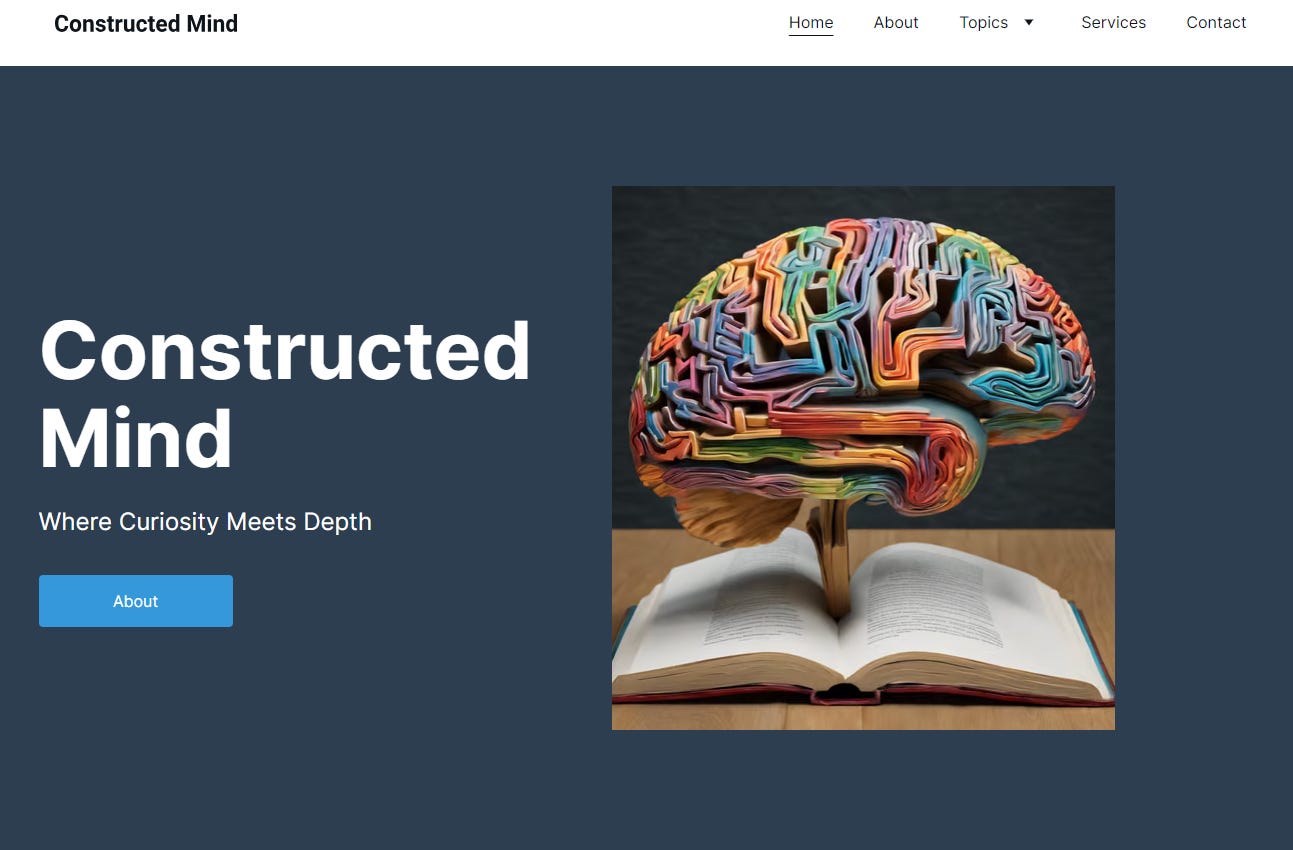
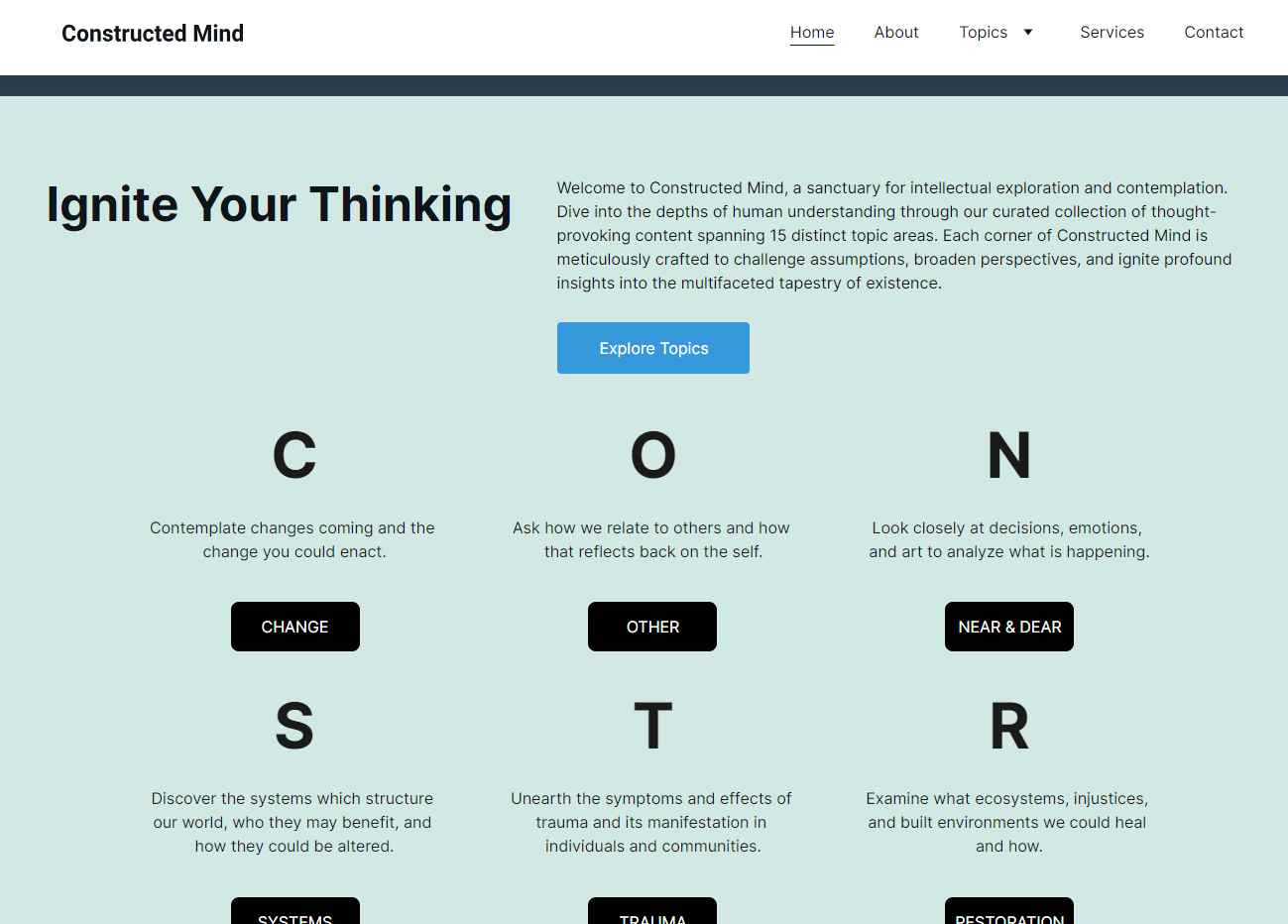
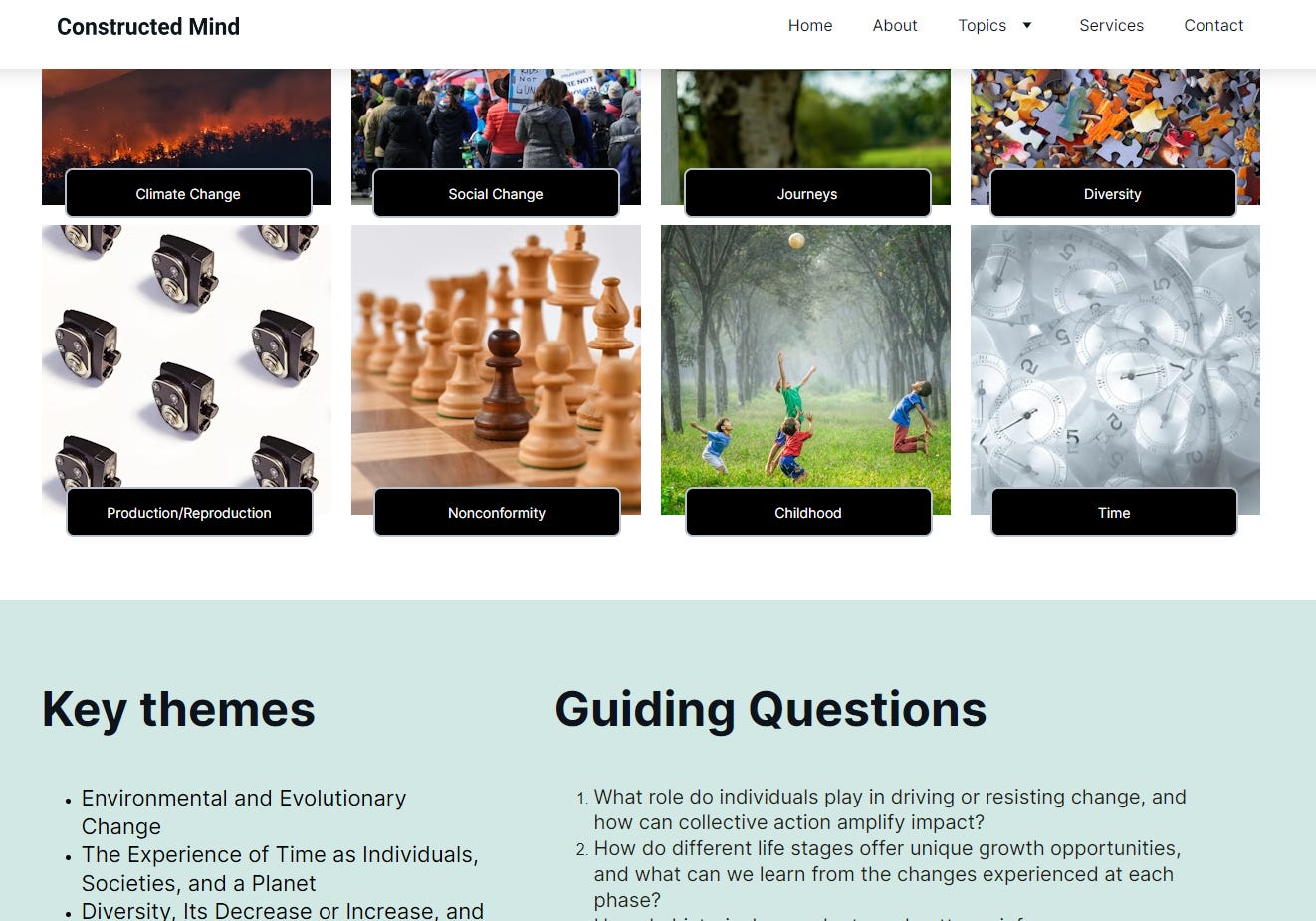
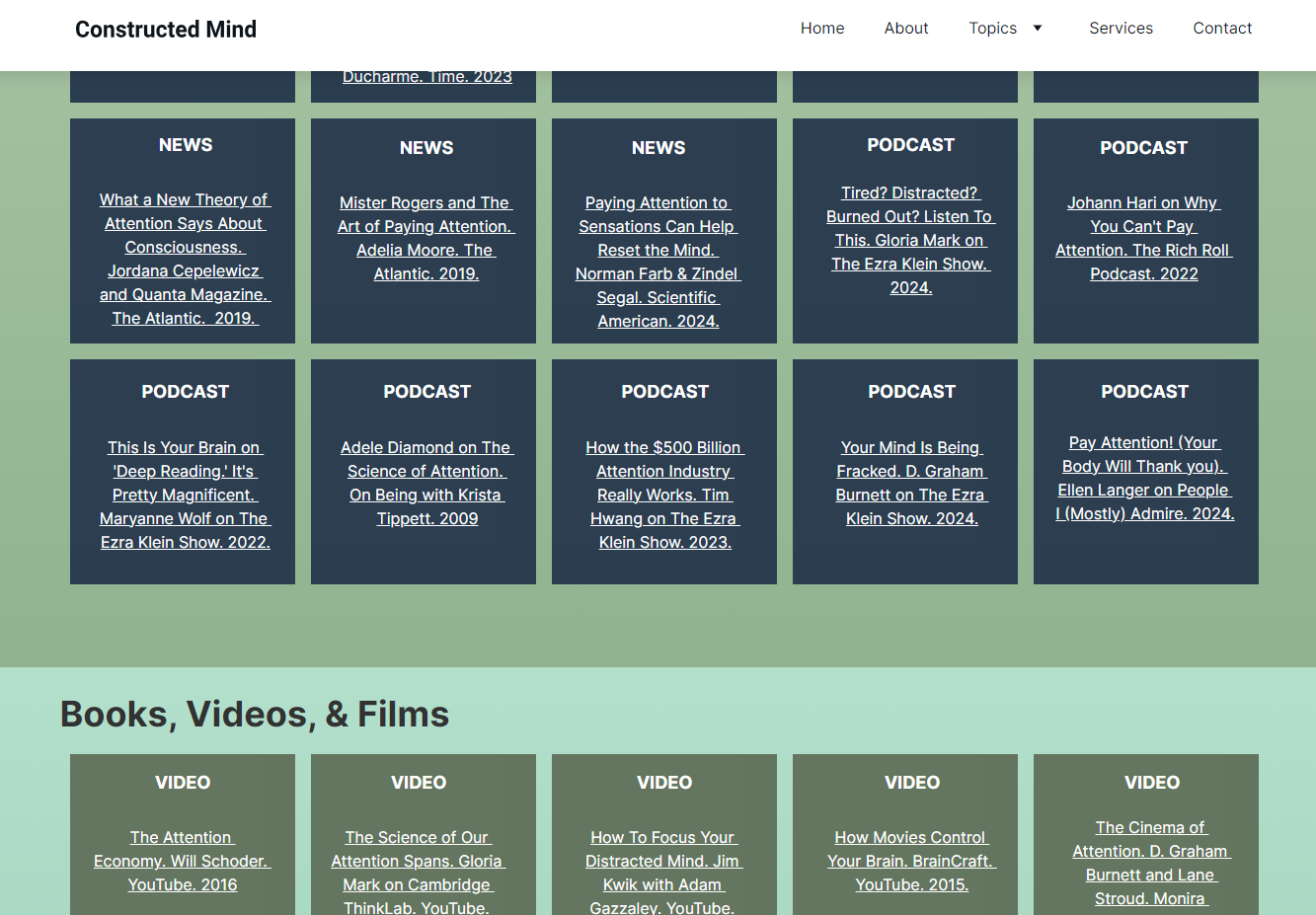
And today, I am also bringing you a sneak peek of the website with these four screen shots.
From your fellow thought explorer and eternal seeker,
Katie