

Under the weather-ization
On nation, narrative, and the storms we create


My eldest son’s father worked briefly in the energy business and a while back, he mentioned the word weatherization. The what? I responded.
Weatherization is the process of protecting a building from sun, wind, and rain; of retrofitting it to decrease energy consumption and boost efficiency. Typical services in a weatherization procedure include: sealing of doors, windows (and other cracks and gaps); replacing old windows and drafty doors; insulating pipes, floors, and sidewalls; installing appropriate drainage and gutters, etc. Weatherization is different from building insulation because that is only one aspect of the “whole-house” approach of weatherization. The house itself is a system and its performance needs to be considered as such. In the United States, buildings are prominent sources of energy usage (up to 2/3’s of all electricity usage) and thereby they produce massive amounts of pollution. The use of buildings produces approximately 50% of our carbon dioxide output. Looking at a building’s energy footprint, there are the following to consider: the resources and energy expended during construction; the daily service of occupants and maintenance of the building once erected; the energy required to demolish and rebuild on the same site…and the list goes on.
Well, apparently, we create our own weather. And then we weatherize against it. We move in circles, it seems, always. Perhaps spirals, if you are more optimistic.
Usually, though, we consider ourselves at the whims of weather—mother nature’s kind. The summer thunderstorm. The wintry blizzard. The oppressive sticky heat of late August. The thick veil of fog wandering in from over the ocean.
Or is our sense of being at Nature’s whim a creation of our own self-deception? In “The Green Language,” a chapter in Raymond William’s The Country and the City—his work using the lens of English literature to understand changing perceptions of the rural and the urban through and beyond the Industrial Revolution—Williams employs an analysis of Wordsworth to reveal a new kind of separation from the natural landscape, different from the idealized pastoral wherein the pains of laboring the land are removed so that the land appears to yield itself, free from the laborer or the negotiation of a social or economic order which is implied to be settled. In Wordsworth,
the labourer now merged with his landscape, a figure within the general figure of nature, is seen from a distance, in which the affirmation of Nature is intended as the essential affirmation of Man. It is in this spirit, at once separated and affirming a submerged general connection—
Sea, hill and wood,
This populous village! Sea and hill and wood
With all the numberless goings on of life
Inaudible as dreams
—that a new emphasis is placed on the act of poetry itself, the act of creation; as Wordsworth described it so often, or as Coleridge put it, from the disturbance within the apparent calm:
And would we aught behold, of higher worth,
Than that inanimate cold world allowed
To the poor loveless ever-anxious crowd,
Ah! from the soul itself must issue forth
A light, a glory, a fair luminous cloud
Enveloping the earth.
It is not now the will that is to transform nature; it is the lonely creative imagination; the man driven back from the cold world in his own natural perception and language seeking to find and recreate man.
The rural land is no longer a mere idealized landscape. Now it is transformed through a creative reimagining that transforms the observer in the process. In fact, that is the point. Nature is mere tool for transforming or recreating man. The laborer, who was by the prior generation of literary artists, mostly ignored, is here in Wordsworth but “merged with his landscape” to become an object of contemplation as is nature itself, neither of them active subjects. Through this distancing trick, rurality and nature exist not to provide for the population economically, nor to be transformative Beauty, but to serve the purposes of poetry itself. And in this “Poet’s mind,” nature is invested with a “quality of creation that is now, in its new form, internal; so that the more closely the object is described, the more directly, in a newly working language and rhythm, a feeling of the observer’s life is seen and known.”
In this Poet’s mind exists the “strange time,” the dislocation of a double movement from remembering to forgetting—a forgetting which is not negligent but immensely purposeful—that Homi Bhabha writes of in “DissemiNation.” In a similar process of distancing from what has been transformed and from what then continues to be transformed through cultural narrative, the broken, discontinuous, separate and yet paradoxically " homogeneous, empty time" of everyone's present must be continually thrown into the past where it is "remembered" as a shared narrative, and yet in that transformation the “strange time,” the “meanwhile” or in simpler terms, the disjunction of what is happening is also captured in the cultural knowledge. We the people, are caught in and split by this doubleness wherein everything in our history happens for a reason (us) at the same time as we live our unequivocally distinct and often conflicting lives. In this way,
The language of culture and community is poised on the fissures of the present becoming the rhetorical figures of a national past…The people are not simply historical events or parts of a patriotic body politic. They are also a complex rhetorical strategy of social reference: their claim to be representative provokes a crisis within the process of signification and discursive address. We then have a contested conceptual territory where the nation's people must be thought in double-time; the people are the historical 'objects' of a nationalist pedagogy, giving the discourse an authority that is based on the pre-given or constituted historical origin in the past; the people are also the 'subjects' of a process of signification that must erase any prior or originary presence of the nation-people to demonstrate the prodigious, living principles of the people as contemporaneity: as that sign of the present through which national life is redeemed and iterated as a reproductive process. The scraps, patches and rags of daily life must be repeatedly turned into the signs of a coherent national culture, while the very act of the narrative performance interpellates a growing circle of national subjects. In the production of the nation as narration there is a split between the continuist, accumulative temporality of the pedagogical, and the repetitious, recursive strategy of the performative. It is through this process of splitting that the conceptual ambivalence of modern society becomes the site of writing the nation.
The mythologized nation, the pedagogical, crashes into the fact of reality imposing its fractured scraps, patches and rags each day. It crashes into the necessity of our own agency.
Let’s make this more tangible. It’s 1933. You are a young child with an older brother and a grandfather who came to Oklahoma to homestead in 1889. Your family has lived on their small plot of land, attempting various crops—like cantaloupe which produced a fine crop but turned out not to have a market—and finally landing on old reliable wheat. Dust is a part of your existence. Sometimes the dust blows and your parents have to turn over the plates in the kitchen and place wet sheets over the baby’s crib. Sometimes, when it gets worse, you retreat to the cellar and you know well the burning feeling of swirling gravel hitting your bare legs as you run there for shelter. At school, the teacher tells you to hide under the stairway in the two-story school house when these storms blow through as it will protect you.
In July of 1933, your mother, pregnant at the time with what will be your younger sister, begins to struggle to breathe with the low dust storms that start rolling more continuously over the land. She takes you and your older siblings and moves into town and, for a month, you live through these “low dust storms”—translation, dust storms that allow you to still see the tops of the telephone poles. These are not the worst of the storms by far. Finally, you all return to your house, but one night—when the dust is blowing heavy and hard—the roof starts to fall in. It is laden with and weighed down by the dust. And your parents grab the baby and all of you run outside. The dust sucks up into your nose and coats your mouth, and you spit it out like tobacco juice.
Your life is meagre. You mostly eat cornbread and beans, with the additional vegetable now and again. But you don’t know any different and you are loved. However, as the storms increase in intensity, as farming becomes more difficult and less reliable, many of your friends and neighbors can’t take it anymore and they leave, often for far destinations out West and you want:
to know if it was as great out there as we thought it was. And nearly everyone left that was close to us but my dad and one of his brothers. And they stuck it out. They stayed through all the Dirty Thirties and everything. My daddy was an optimist. I think he just kept thinking, “Next year will be better and we’ll have a good crop and we’ll raise some more cattle and we’ll get rich.” We never did, but he thought we would. He was a good farmer and he was a good cattleman and he — he really believed that everything would work out for the best, that we’d have a good crop and — and everything would be better. (A Child of the Dust Bowl, American Experience)
Some of these migrants to California continued to live as migrants, following the harvests for work. California was not the dream-state they imagined. Life was equally, just differently, as harsh. There were many others living lives in the 30s entirely untouched by the Dust Bowl. At the time, they likely would have heard or cared very little about the goings-on in Oklahoma. They were managing their own scraps and rags, as we all do.
A century later, “the Dust Bowl” is a lesson in history books, a seeming coherence, a thing unto itself, a swirling mass of winds and dirt that transformed into Woody Guthrie’s folk songs and Dorothea Lange’s photographs and Steinbeck’s The Grapes of Wrath, cultural items—indeed scraps—-but our scraps, the scraps of our national challenges and resilience, the winds that lead inevitably to us. And yet the meanwhile, the present where “succession without synchrony” resides is that remembering to forget, this obligation we have to something—anything—that could be shared as a people. Here is the endless problem: we are not a totality and we never were. And yet we require some kind of story to exist in nationhood. The sheer number of individual lives and stories and opinions and beliefs continually destroy this possibility. As Bhabha writes: “Number breaks down unity, destroys unity.” We do not have one coherent and consistent historical memory. We couldn’t. What we have, what any nation has, is a rhetoric that repeats the national memory as succession and it is within this process that exists our obligatory forgetting.
At the end of “DissemiNation,” Bhabha ruminates on the English weather:
To end with the English weather is to invoke, at once, the most changeable and immanent signs of national difference. It encourages memories of the ‘deep’ nation crafted in chalk and limestone; the quilted downs; the moors menaced by the wind; the quiet cathedral towns; that corner of a foreign field that is forever England. The English weather also revives memories of its daemonic double: the heat and dust of India; the dark emptiness of Africa; the tropical chaos that was deemed despotic and ungovernable and therefore worthy of the civilizing mission.

In contrast to America, the English weather is powerfully correlated with its national identity. With its dreary rain soaked landscapes and gray cities, we imagine—as Kate Flint describes in her article on the topic—
the British Isles as caught in a perpetual downpour. But contrary to reputation, it doesn’t always rain in England. In the Victorian age, the painter and printmaker Samuel Palmer—the subject of William Vaughan’s recent scholarly biography—created iconic pastoral landscapes suspended in a golden summer haze: they are a nostalgic and idealised antithesis to the damp streets Parr photographed just over a century later. Farther afield, the Scottish writer Peter Davidson meditates on the particular qualities of northern twilight, in a work that extends beyond national borders but has deep resonance for the English environment. Davidson considers light and atmosphere’s role in defining cultural depictions of mood. If sometimes flat and gray, this twilight can also be a long instance of luminous suspended time, albeit one underscored with the inevitability of transience and loss. Most ambitiously, Alexandra Harris’s cultural history of English weather compellingly describes over a millennium of literary representations of weather foul and fair. While noting long-term climatic changes, Harris analyzes why writers and artists in certain periods appear to take particular notice of bright springtime, or frost and chill winds, or mutable clouds, or Mediterranean-style sun. In her hands, predominant associations of weather, landscape, and nationhood prove as unstable as the English climate itself.
Weather is an unstable as Bhabha’s meanwhile—the “jarring of meaning and values generated in the process of cultural interpretation,” the thirdspace beyond the doubleness, beyond the weather of England merely invoking its imagined opposite in the weather of Africa which becomes its antagonist in values and knowledge, wherein those who have been marginalized in particular signification—or, one could say, placed under the weather—always re-emerge, in a very real way, as subjects within the liminal space of the nation.
But it is the weather that directs, guides, and shepherds us to different understandings. We say we feel under the weather when we are ill or out of sorts. Like sailors ducking below deck to escape the inevitable storms at sea, weather is beyond our grasp, its powers always out of our control despite the appearance of our mastery of other aspects of nature and the environment. All we can do with weather is watch, or track, or historicize. We use instruments to follow and predict and understand patterns of weather. But we are still only addressing the what with the why still eluding. Ancient cultures had gods who controlled the weather, often for punishment like Poseiden to Odysseus. We analyze; they mythologized. Is the difference so great, though? They are both stories, ours more scientific, but as Pi poses in Life of Pi, it may not be a question of facts, but a question of which is “the better story”?
Our stories are not as clear and distinct as we may like to believe. The meanwhile. When it rains suddenly and heavily, we still say that the heavens opened. Weather remains one of our gods. We are under the weather because we recognize our powerlessness, our transience, our inability to lift out of the atmosphere. Or perhaps we are stuck on a ship and, feeling ill, slink down to huddle under the weather deck. Under the weather is suffering. Under the weather is the pain of love lost. Under the weather is “simply irrational weather. I can’t even hear myself think.” Under the weather is KT Tunstall lost and alone. Under the weather is why Bob Dylan was “tangled up in blue.”
Under the weather is Goethe’s Werther sinking in forlorn, lovesick fever, mired in sturm und drang, witnessing the paling of his own life as his paramour becomes increasingly distant:
October 30: One hundred times have I been on the point of embracing her. Heavens! What a torment it is to see so much loveliness passing and repassing before us, and yet not dare to lay hold of it! And laying hold is the most natural of human instincts. Do not children touch everything they see? And I!
November 3: Witness, Heaven, how often I lie down in my bed with a wish, and even a hope, that I may never awaken again. And in the morning, when I open my eyes, I behold the sun once more, and am wretched. If I were whimsical, I might blame the weather, or an acquaintance, or some personal disappointment, for my discontented mind: and then this insupportable load of trouble would not rest entirely upon myself. But, alas! I feel it too sadly…. I suffer much, for I have lost the only charm of life: that active, sacred power which created worlds around me — it is no more. When I look from my window at the distant hills, and behold the morning sun breaking through the mists, and illuminating the country around, which is still wrapped in silence, whilst the soft stream winds gently through the willows, which have shed their leaves; when glorious nature displays all her beauties before me, and her wondrous prospects are ineffectual to extract one tear of joy from my withered heart, I feel that in such a moment I stand like a reprobate before heaven, hardened, insensible, and unmoved. Oftentimes I do then bend my knee to the earth, and implore God for the blessing of tears, as the desponding labourer in some scorching climate prays for the dews of heaven to moisten his parched corn. But I feel that God does not grant sunshine or rain to our importunate entreaties.
Werther is under the weather when his surroundings fail to mirror his emotional state. The pain of dislocation. He becomes even more isolated because the weather is not his weather. He is under a different sort of weather altogether—her weather, her “active, sacred power which created worlds around” him. He lives in her weather, her atmosphere without her presence. The wind of memory minus the source of the memory’s joy. The remembrance without the being. The weather without the season. The breath and flurry and flutter of erasure, of absence.
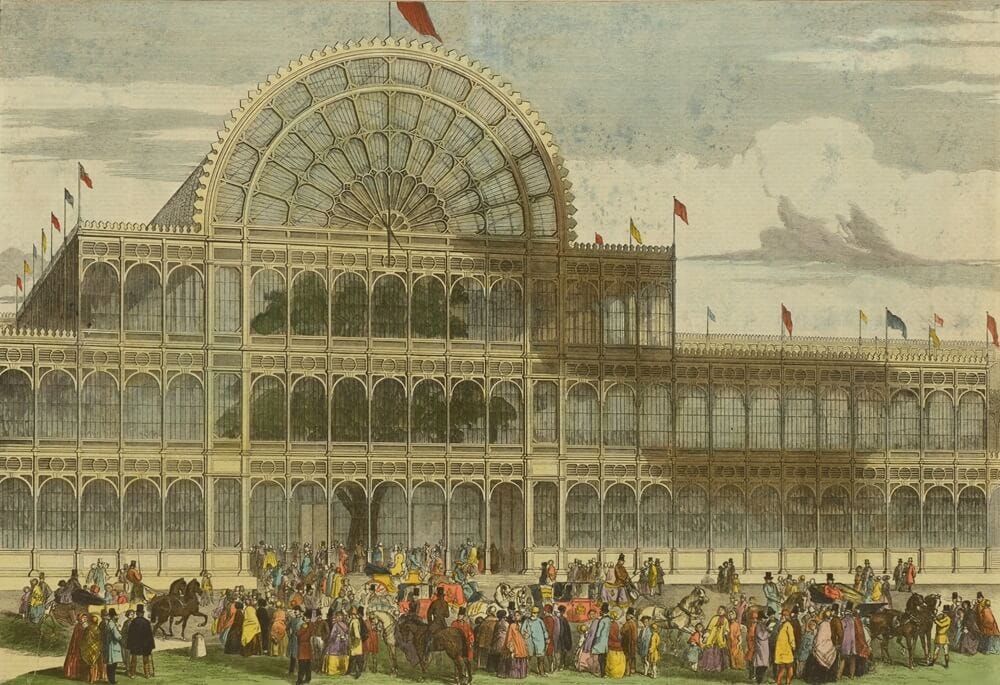
And so, we search for meaning—in the landscape, in the weather, maybe in the gods we don’t believe in. We construct a crystal palace to enclose and embody and illuminate, but perhaps in the melting rain that falls upon its former site, that highlights both its existence and its non-existence and the supplemental meanwhile, we find both a memory and a cleansing for “it is the mystery of the quotient… [and] upon us all a little rain must fall.” (Led Zeppelin, “The Rain Song”)
In the meantime,
Katie